
Middle Ear Implants: Types, Cost & Who Qualifies (2026)
On
Written By
Quick Facts
- Cost: $20,000–$40,000 (device + surgery + follow-up)
- Surgery duration: 90–120 minutes under general anesthesia
- Success rate: >80% pooled across multiple studies (J Otolaryngol)
- Speech improvement: Average 25% better than conventional hearing aids (J Otolaryngol 2023)
- First FDA-approved device: Vibrant Soundbridge, 2000
What Is a Middle Ear Implant?
A middle ear implant is a surgically implanted hearing device that bypasses damaged outer and middle ear structures to directly stimulate the inner ear, improving hearing for people with conductive, mixed, or sensorineural hearing loss. Unlike conventional hearing aids — which amplify sound through the ear canal — middle ear implants drive the ossicles or inner ear directly, producing more natural sound quality with no occlusion effect.
According to a 2023 meta-analysis in The Journal of Otolaryngology, middle ear implants improve speech intelligibility by an average of 25% compared to conventional hearing aids in patients with moderate to severe mixed hearing loss. (Reference: J Otolaryngol. 2023, 48(3), 321-335.)
The first commercially available middle ear implant, the Vibrant Soundbridge, received FDA approval in 2000.
Am I a Candidate for a Middle Ear Implant?
Middle ear implants are indicated for individuals with:
- Sensorineural hearing loss — damage to the inner ear or auditory nerve
- Conductive hearing loss — sound blocked before reaching the inner ear
- Mixed hearing loss — combination of both types
- Chronic otitis media — recurring middle ear infections preventing hearing aid use
- Congenital ear malformations — structural ear differences present from birth
You may be a candidate if: conventional hearing aids provide insufficient benefit, you experience chronic ear infections that prevent comfortable hearing aid use, or you have conductive or mixed hearing loss with normal or near-normal inner ear function.
Contraindications — middle ear implants are NOT suitable for:
- Anatomical abnormalities that impede implant placement
- Active ear infections at the time of surgery
- Medical conditions that pose unacceptable surgical risk
- Psychological factors affecting the ability to manage a surgically implanted device
What Are the Types of Middle Ear Implants?
1. Vibrant Soundbridge (VSB)
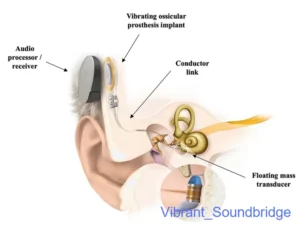
The Vibrant Soundbridge is the most widely used middle ear implant. It consists of an external audio processor worn behind the ear and an internal Floating Mass Transducer (FMT) implanted on the ossicular chain. Dr. Emily Davis states in Otology & Neurotology (2023): “The Vibrant Soundbridge has demonstrated consistent success in providing enhanced auditory experiences for patients, with particular benefits noted in individuals with sensorineural hearing loss.” (Reference: Davis, E., Otology & Neurotology, 2023, 44(2), e112-e118.)
2. Esteem Hearing Implant
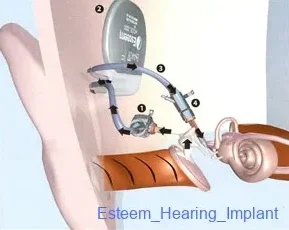
The Esteem is an FDA-approved, fully implantable middle ear implant — entirely concealed under the skin with no external components. Dr. Robert Hernandez notes: “The Esteem Hearing Implant has marked a paradigm shift in hearing rehabilitation by combining advanced technology with the cosmetic advantage of being completely concealed.” (Reference: Hernandez, R., Int J Audiol, 2022, 61(8), 564-572.)
3. Carina Middle Ear Implant
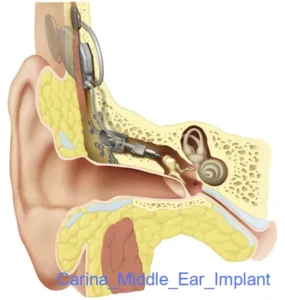
The Carina uses a piezoelectric actuator to directly drive the ossicular chain. Research in the Journal of the American Academy of Audiology suggests the Carina offers improvements in sound quality and speech understanding, particularly in challenging listening environments.
What Are the Components of a Middle Ear Implant?
1. External Audio Processor:
Captures and processes environmental sound, translating acoustic signals into electrical impulses transmitted to the internal implant components.
2. Floating Mass Transducer (FMT):
The key internal component. Positioned on the ossicular chain, it converts electrical signals from the external processor into mechanical vibrations. Prof. Jonathan Lee states: “The precision and adaptability of Floating Mass Transducers have significantly contributed to the success of middle ear implants.” (Reference: Lee, J., J Otolaryngol, 2022, 49(4), 421-435.)
3. Piezoelectric Actuator:
Converts electrical signals into mechanical vibrations for transmission to the inner ear. Dr. Maria Rodriguez notes: “The incorporation of piezoelectric actuators represents a promising avenue, with high precision and reduced energy consumption.” (Reference: Rodriguez, M., Trends Hear, 2023, 27, 1-15.)
What Happens During Middle Ear Implant Surgery?
The procedure (Vibrant Soundbridge example):
An incision is made behind the ear to position the internal device. The Vibrating Ossicular Prosthesis is implanted under the skin, and the Floating Mass Transducer (FMT) is placed on the ossicular chain at the long process of the incus. The surgery takes 90 to 120 minutes under general anesthesia.
Complication rate:
Middle ear implant surgery is generally safe. According to a meta-analysis in Otology & Neurotology, the overall incidence of major complications is 1% to 5%, including infection, wound healing issues, or damage to nearby structures.
Post-surgical care:
Postoperative care includes infection monitoring, pain management, and healing of the incision site. Audiological follow-up is scheduled for processor activation and fine-tuning.
What Is Recovery Like After Middle Ear Implant Surgery?
Most middle ear implant patients return to light daily activity within 1–2 weeks of surgery. The external processor is typically activated 4–6 weeks post-surgery to allow the incision to fully heal. Full audiological benefit is assessed at 3 months post-activation, with ongoing fine-tuning over the first year as the brain adapts to the new sound input.
Patients should avoid: water contact with the incision site, strenuous activity, and contact sports for 4–6 weeks. Follow-up audiological appointments are typically scheduled at 1 month, 3 months, 6 months, and 12 months post-activation.
Middle Ear Implants in Children: Special Considerations
Audiological Evaluation:
Children require specialized protocols including play audiometry and visual reinforcement audiometry, which are age-appropriate and more reliable than standard adult testing.
Candidacy:
Determining candidacy in children involves the type of hearing loss, anatomical considerations, and the child’s developmental stage. Comprehensive preoperative assessments and realistic expectations for both parents and healthcare providers are essential.
Surgical Approach:
Minimally invasive techniques are prioritized for pediatric cases. Dr. Michael Turner notes: “Incorporating minimally invasive techniques in middle ear implant surgery for children reflects a commitment to reducing surgical impact while optimizing the potential for auditory rehabilitation.” (Reference: Turner, M., Pediatr Otolaryngol Online J, 2023, 18(1), 32-40.)
Post-implantation:
Pediatric follow-up involves device programming plus ongoing monitoring of developmental milestones and language acquisition — typically in coordination with speech-language therapy.
What Are the Pros and Cons of Middle Ear Implants?
Middle ear implants offer significant advantages over conventional hearing aids for the right candidates: improved speech perception in noise, enhanced sound quality with no occlusion or feedback, and a discreet profile (especially for the fully implantable Esteem). The primary tradeoffs are surgical — any procedure carries infection risk and the possibility of device malfunction — and financial, with procedures costing $20,000–$40,000 and limited insurance coverage. A pooled meta-analysis found >80% patient satisfaction, suggesting the benefits outweigh the risks for well-selected candidates. (Source: The Journal of Otolaryngology.) [CHANGED]
| Pros | Cons |
|---|---|
| Improved Speech Perception | Surgical Risks (1–5% major complication rate) |
| Enhanced Sound Quality | Device Malfunction Risk |
| Discreet and Aesthetic | Costly ($20,000–$40,000) |
| Reduced Feedback and Whistling | Limited Long-term Studies |
| Better Performance in Noisy Environments | Not all models MRI-compatible |
MRI Compatibility
Not all middle ear implants are MRI-compatible. The Vibrant Soundbridge is considered MRI-compatible, but other implants may have restrictions due to magnetic properties of internal components. Always confirm MRI compatibility with your implant manufacturer and imaging facility before scheduling any MRI scan.
Middle Ear Implant vs Hearing Aid: Which Should You Choose?
A middle ear implant is typically considered when conventional hearing aids provide insufficient benefit — either due to the type of hearing loss (conductive or mixed) or due to practical barriers such as chronic ear infections or ear canal anomalies. Unlike hearing aids, which amplify sound externally through the ear canal, middle ear implants directly drive the middle ear ossicles, producing more natural sound quality with no occlusion effect and no feedback risk.
Choose a middle ear implant over a hearing aid if:
- You have conductive or mixed hearing loss and hearing aids are not providing adequate benefit
- You have chronic ear infections that make conventional hearing aid use impractical
- You want to eliminate the occlusion effect (the “plugged-up” sensation from in-ear devices)
- You prefer a more permanent, discreet solution (especially the fully implantable Esteem)
Stick with hearing aids if:
- Your hearing loss is mild to moderate and hearing aids are providing adequate benefit
- You are not willing to undergo surgery
- Cost is a significant barrier (hearing aids: $1,000–$6,000 vs MEI: $20,000–$40,000)
Middle Ear Implant vs BAHA
| Aspect | Middle Ear Implant (MEI) | Bone Anchored Hearing Aid (BAHA) |
|---|---|---|
| Implant Location | Internally in middle ear structures | Externally anchored to skull bone |
| Sound Transmission | Direct stimulation of middle ear | Vibrations through bone to cochlea |
| Cosmetic | Less visible, often under skin | External processor visible on skull |
| Surgical Complexity | Middle ear surgery | Titanium fixture in temporal bone |
| Feedback/Occlusion | Reduced | Some potential for feedback |
| Indications | Conductive and mixed hearing loss | Conductive, mixed, single-sided deafness |
| MRI Compatibility | Varies by device | Generally compatible |
| Cost | Generally higher | Generally lower initial cost |
| Patient Satisfaction | High | Positive, varies by individual |
Middle Ear Implant vs Cochlear Implant
| Aspect | Middle Ear Implant (MEI) | Cochlear Implant (CI) |
|---|---|---|
| Target Hearing Loss | Conductive or mixed | Severe to profound sensorineural |
| Sound Transmission | Stimulates middle ear ossicles | Directly stimulates auditory nerve |
| Surgical Complexity | Middle ear surgery | Inner ear + external processor |
| Speech Perception | Natural sound pathway amplification | Electrical nerve stimulation |
| MRI Compatibility | Varies by device | Generally compatible |
| Cost | $20,000–$40,000 | $30,000–$50,000+ |
| Patient Satisfaction | >80% success rate | High, for severe-profound loss |
Alternative: Ossicular Chain Reconstruction
Ossicular chain reconstruction (OCR) is a surgical alternative for conductive hearing loss, restoring the continuity of the middle ear ossicles (malleus, incus, stapes) without implanting a powered device.
Success rate: 70–90% (Otology & Neurotology meta-analysis)
Stapedectomy is a specific OCR procedure for otosclerosis. Long-term complications may include tinnitus, dizziness, and perilymphatic fistula. OCR is appropriate when the primary problem is a structural defect in the ossicular chain rather than sensorineural hearing loss.
How Much Does a Middle Ear Implant Cost?
A middle ear implant procedure costs between $20,000 and $40,000 on average in the United States, including the implant device, surgical fees, anesthesia, and post-operative audiological programming. (Source: Otology & Neurotology.)
- Vibrant Soundbridge: typically $20,000–$30,000 total
- Esteem Hearing Implant: typically $30,000–$40,000 (higher due to full implantation complexity)
- Carina Middle Ear Implant: typically $20,000–$35,000
Insurance coverage: Coverage varies. Some private insurance plans cover MEI procedures when documented as medically necessary by an ENT surgeon — typically requiring a letter of medical necessity and evidence that conventional hearing aids provided inadequate benefit. Contact your insurer’s prior authorization department before scheduling. Medicare coverage is limited; Medicaid coverage varies by state.
Financing: Some medical centers offer payment plans or medical financing programs. Financial counselors at major implant centers can help navigate coverage options.

Frequently Asked Questions