
Editorial Policy & Testing Methodology
Effective Date: November 26, 2024
Last Reviewed & Updated: May 2026
Clinical Review Sign-off: Dr. Jean Marcel Mourgues, MD & Dr. David Gathers, Au.D
Welcome to HearingHealth.pro. Our primary mission is to translate complex audiological and technical hearing aid specifications into clear, evidence-based, and practical guidance that consumers can trust.
To maintain the highest tier of Experience, Expertise, Authoritativeness, and Trustworthiness (E-E-A-T), we align our publishing standards with the leading clinical authorities in the audiology space, ensuring all content undergoes rigorous scientific verification and medical oversight.
1. How We Test: Our 5-Pillar Evaluation Process
We do not write generic reviews based on marketing brochures. Every hearing aid, over-the-counter (OTC) device, and accessory evaluated by HearingHealth.pro undergoes a strict, structured 5-Pillar Evaluation Process overseen by our clinical and technical experts.
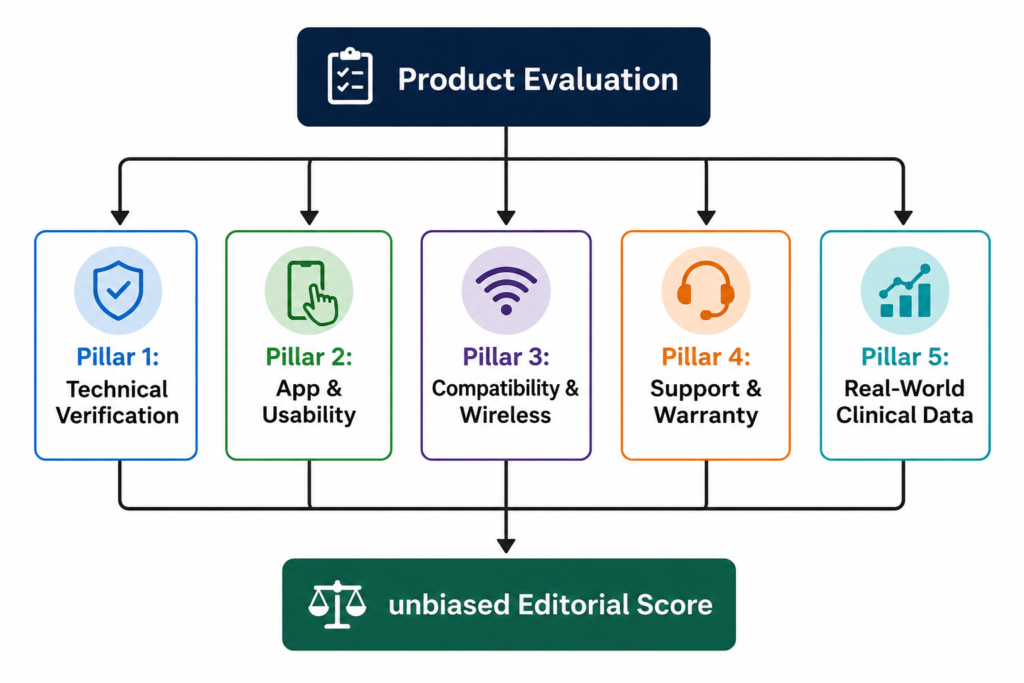
Pillar 1: Technical & Clinical Verification
We audit the raw acoustic and medical specifications of each hearing aid. This includes:
- Fitting Ranges: Verifying the device’s performance envelope against specific degrees of hearing loss (mild, moderate, severe, or profound).
- Acoustic Output: Sanity-checking the maximum power output (MPO) and high-frequency gain curves.
- Battery & Power Management: Comparing manufacturer-claimed battery runtime (rechargeable and disposable) against active real-world usage patterns (e.g., active streaming vs. passive wear).
Pillar 2: App & Usability Audit
Modern hearing aids rely heavily on software. We spend hands-on time with the companion iOS and Android apps, testing:
- Program Flexibility: The ease of creating and selecting custom environmental programs (e.g., Speech-in-Noise, Music, Restaurant, Tinnitus Masking).
- Manual Controls: Testing the responsiveness of volume adjustments, microphone directional steering, and frequency adjustments (treble/bass/middle).
- Interface Accessibility: Evaluating font sizes, button layouts, and the simplicity of navigation for older adults or individuals with physical dexterity challenges.
Pillar 3: Compatibility & Wireless Connectivity
We evaluate how seamlessly the devices integrate into a user’s existing digital ecosystem:
- Protocol Audits: Testing performance across standard Bluetooth Classic, MFi (Made for iPhone), ASHA (Audio Streaming for Hearing Aids), and the latest Bluetooth LE Audio and Auracast broadcast standards.
- Streaming Reliability: Measuring audio latency, connection dropouts, and the clarity of hands-on, two-way calling.
- Cross-Device Performance: Verifying stability when switching connections between smartphones, tablets, smartwatches, and television transmitters.
Pillar 4: Customer Support, Warranty & Business Integrity
A hearing aid is a long-term investment. We evaluate the consumer protections behind the purchase:
- Trial Periods & Refunds: Verifying the exact length of the risk-free trial (minimum of 45 days expected for prescription models) and the presence of hidden restocking fees.
- Warranty Coverage: Auditing the duration and terms of the manufacturer’s warranty (loss, damage, and repair coverage).
- Retailer Legitimacy: Assessing the transparency of the distributor, whether they are a national clinic chain, a remote tele-audiology provider (e.g., Jabra Enhance), or an OTC online store.
Pillar 5: Real-World Clinical Feedback & Post-Purchase Data
We balance technical lab specs with authentic human experiences:
- Acoustic Realities: Analyzing aggregated data from users detailing comfort, physical retention, and dome/receiver occlusion issues.
- Clinical Oversight: Ensuring every review is reviewed and sanity-checked by our medical advisory board to verify that the device’s performance expectations align with real-world audiological practice.
2. Editorial Independence & Conflict of Interest
HearingHealth.pro is 100% independently owned and operated. To ensure our readers receive unbiased recommendations, we maintain an absolute separation between our editorial decisions and our commercial partnerships.
[!IMPORTANT]
Our Golden Rule of Editorial Integrity:
- No Pay-for-Play: We never accept financial compensation in exchange for guaranteed positive reviews, high ratings, or specific placement in our comparison guides.
- No Advertiser Influence: Our corporate sponsors, battery manufacturers, and affiliate networks have zero input, veto power, or preview rights over our editorial content, reviews, or comparative analysis.
- Objective Limitations: Every product review will explicitly highlight both the strengths and the limitations of a device, regardless of our commercial relationship with the brand.
- Affiliate Transparency: While we may earn a commission if you purchase through our links, the cost to you remains exactly the same, and we will never recommend a low-value or clinically inadequate product simply to earn a fee.
3. Medical Review & Expert Oversight
Because hearing loss directly impacts systemic physical health, cognitive decline, and mental well-being, we treat all hearing content as high-risk YMYL (Your Money or Your Life) medical information.
- Clinical Advisory Board: All major guides, brand comparisons, and clinical explanations are written or clinically reviewed by credentialed medical experts, including licensed physicians and Doctors of Audiology.
- Verifiable Credentials: We do not use anonymous review panels. Our reviewers’ names, licensing credentials (such as French RPPS registrations and US state audiology licenses), and professional profiles are fully disclosed and linked to public licensing directories.
- Continuous Updates: Medical science and device technology evolve constantly. We review and update our clinical libraries and testing logs semi-annually. Each reviewed article clearly states the date it was last evaluated.
4. The Editorial Corrections Pathway
We hold ourselves to the highest standards of accuracy. Despite our rigorous clinical and technical screening, errors may occasionally occur. We invite our community, healthcare professionals, and manufacturers to hold us accountable.
[!TIP]
How to Report a Clinical or Technical Error:
If you detect an audiological error, a technical specification mismatch, or an outdated price on our platform, please follow our formal corrections pathway:
- Email:
contact@hearinghealth.pro- Subject Line:
Editorial Correction- Required Information: Please provide the specific URL of the article, the exact paragraph or specification in question, the proposed correction, and any supporting clinical or manufacturer documentation.
Our Commitment: We commit to reviewing, clinically verifying, and updating all validated inaccuracies within 72 business hours of submission.
5. Our Editorial Team
- Dr. Jean Marcel Mourgues, MD
General Practitioner & Founder
DES Médecine Générale, Faculté de Médecine de Bordeaux (1989)
RPPS Registry No: 10002791704
Location: Pujols, France - Dr. David Gathers, Au.D
Clinical Reviewer & Audiology Expert
Doctor of Audiology, Vanderbilt University Medical Center
Location: Denver, Colorado, USA